
Growing Together: how a PD trip to Reggio Emilia is benefitting students in the classroom
This spring, Burgundy teachers Andrea Brown and Barbie Holland traveled to Italy to take part in a week-long study of the Reggio Emilia approach, an internationally respected philosophy of early childhood education. Originating in the town of Reggio Emilia after World War II, the approach emphasizes children as capable, curious, and deeply connected to their communities. Much like Burgundy, it is rooted in intentional learning environments, collaborative relationships, and a deep respect for children’s voices.
Barbie explains, “The Reggio Emilia approach was born in the aftermath of World War II. Parents and community members made a fundamental choice that in order to rebuild their city, they must start with the education of the youngest inhabitants. They believed peace must be developed at a young age, starting with learning to listen and converse with others, and building reciprocal relationships without imposing one’s will.”
Andrea adds, “Learning about this historical context was incredibly powerful. The community’s decision to invest in early childhood education, believing it was the path to a peaceful and equitable society, remains at the heart of their work today.”
For Andrea, the trip was about deepening her understanding of Reggio philosophy directly from those who live it every day. “I wanted to find meaningful, concrete ways to bring Reggio principles into our work at Burgundy,” she says. “I suspected there was significant overlap in our shared values, and I was asking: How can we evolve our learning environments, teacher roles, parent involvement, and material use to reflect Reggio-inspired practices while staying true to our mission?”
Barbie had been introduced to Reggio during her undergraduate studies but longed to see it in action. “When I was given the opportunity to participate in the Reggio study group, I was overjoyed,” she recalls. “My goal was to soak up as much information as possible and use it to expand my practice, as well as inspire new initiatives at Burgundy.”
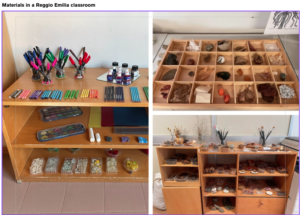
During the week, the group visited infant/toddler centers, preschools, and a primary school, touring classrooms, viewing documentation of student projects, and speaking directly with teachers. Andrea was struck by the intentionality of every learning space. “In Reggio, every environment or ‘context’ is designed to provoke thought, dialogue, and discovery,” she explains. “The classroom is just one context; the kitchen, outdoor spaces, and the piazza are equally vital.”
Barbie was deeply inspired by how materials are valued. “Yes, there’s a place for traditional toys,” she says, “but there’s a broader focus on natural and repurposed materials—like cardboard, plastic jugs, or bamboo. The question becomes: ‘What can this material teach us?’ This reframing encourages children to slow down, observe, and reflect.”
So many of these practices are in direct harmony with Burgundy’s early childhood program. Andrea has already made some additional subtle but meaningful shifts based on what she saw. “One small change is that I talk less,” she says. “Instead of jumping in with solutions, I pause and listen, which lets children’s voices grow stronger. They begin addressing each other, not just looking to me for answers.”
Barbie has begun integrating the material-centered mindset into her classroom. She now offers more open-ended, sustainable materials and guides students to reflect on what the materials reveal. “This type of thinking promotes deeper critical thinking and nurtures curiosity about the world,” she says.
Both educators returned with a renewed understanding of the teacher’s role. Andrea notes, “We become designers of learning contexts, stewards of classroom culture, and co-researchers with our students. One presenter shared, ‘You have to have care for care to take place.’ That’s stayed with me.”
Barbie was moved by the societal belief in Reggio that education is a right of all children, and the responsibility of the collective. “They highly value the first six to eight years of life as the foundation for lifelong learning and social integration. Being in a place where this belief is embedded into daily life was empowering.”
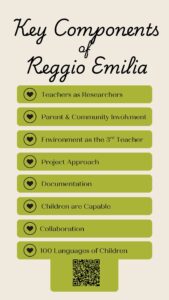
Both teachers saw strong parallels between Burgundy’s philosophy and Reggio’s, particularly in respect for nature, social-emotional learning, and close family involvement. Andrea was inspired by the Reggio practice of “listening”—an intentional, mindful attention to children, materials, and the environment. Barbie was intrigued by how families are engaged throughout the learning process, not only at the end. “Families are invited in at the start of new explorations, to reflect and ask questions that can shape where the learning goes,” she says. “We’d like to explore how to bring an even deeper involvement to Burgundy.”
The trip sparked long-term ideas for both teachers. Barbie wants to design more collaborative outdoor spaces on Burgundy’s campus, similar to the open-ended natural areas in Reggio schools. She also sees potential to use Burgundy’s gathering spaces more intentionally, like the Logan Loft, Campus Commons, and outdoor amphitheater, to build stronger cross-age relationships.
Andrea is thinking about how to bring the spirit of the piazza—a shared space for community learning—into Burgundy’s unique campus layout. She’s also exploring ways to document learning in ways that are meaningful to both children and families.
For both educators, the trip was more than professional development—it was a reaffirmation of why they teach. Andrea reflects, “Reggio left an indelible mark on my teaching soul. To be in a city where early childhood education is publicly funded, celebrated, and visible was a powerful reminder of what’s possible.” Barbie agrees, “It validated and renewed my purpose as an early childhood educator. I came home inspired not only to deepen my own practice, but to help our community grow in how we honor the voices and relationships of our youngest learners.”
The thoughts shared by Andrea and Barbie reflect some of the ideas that are already embraced at Burgundy: that children are capable, their ideas are valuable, and their learning is enriched when adults slow down, listen, and create spaces for exploration. Their journey to Reggio Emilia may be over, but its influence will continue to shape their work and Burgundy’s classrooms for years to come.
Inquire Now
Black History Month 2025 at Burgundy
Our spring teams have become more competitive; the teamwork throughout the school day and during games is beautiful to see, and the leadership from our 8th graders has been phenomenal.

Burgundy is a one-of-a-kind independent school for Junior Kindergarten through 8th Grade. We believe children learn best in an inclusive, creative, and nurturing environment that engages the whole child.
3700 Burgundy Road
Alexandria, VA 22303
703.960.3431
Accredited by:
Affiliated with:
Partners with:
©2026 Burgundy Farm Country Day School
Designed and developed by The Design Channel